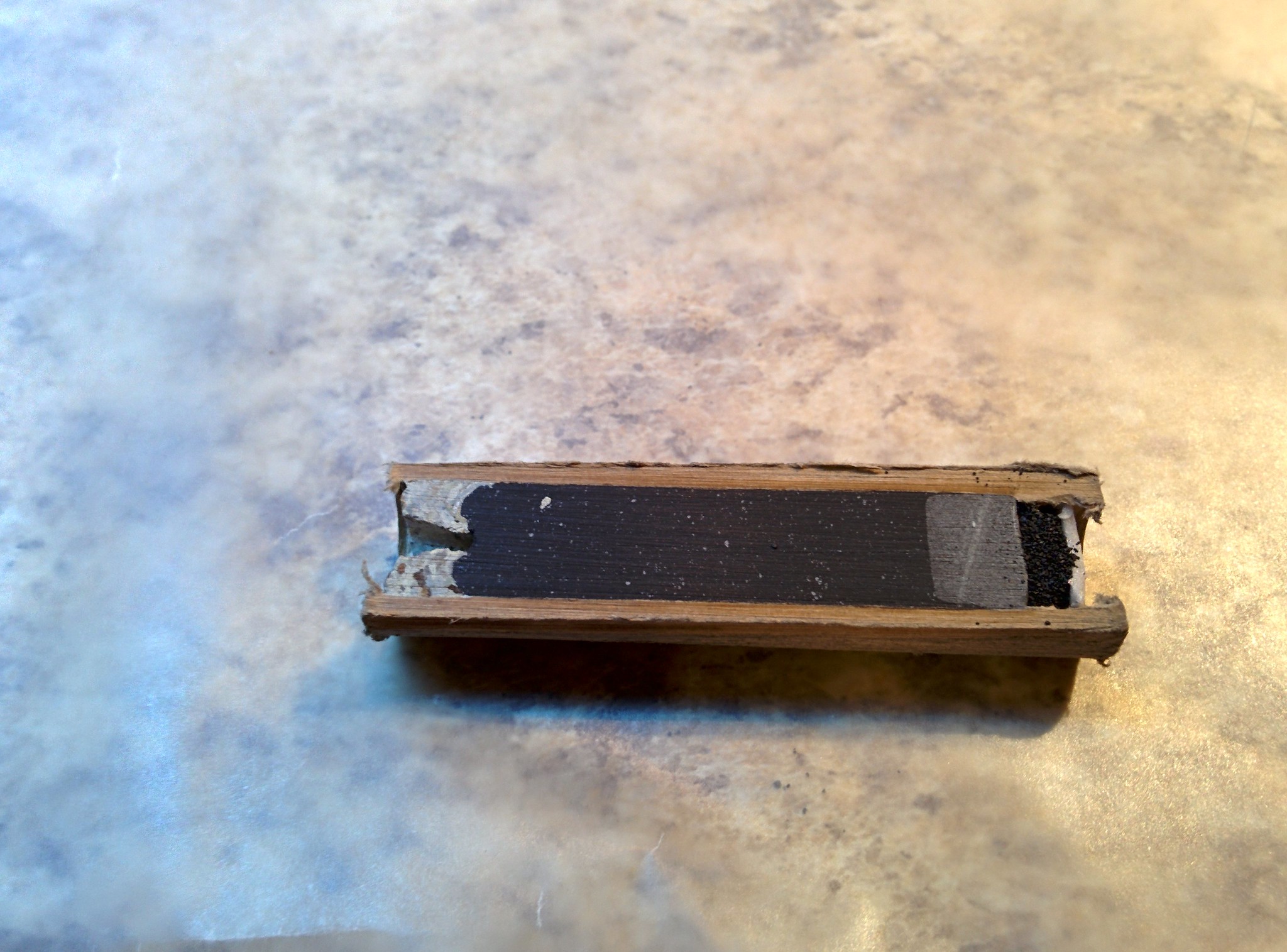
Fun fact: the shape of the propellant determines the thrust curve as it burns, as thrust is proportional to the surface area burning. And as material burns away, the surface area changes according to the pre-burn geometry.
I love recalling my feelings from the day somebody told me that thrust profiles related to surface area of the burn in solid fuel rocket motors. (That's kind of an odd sentence...)
It's a silly thing little, perhaps, but it helped shape my personality.
When I got involved with high power model rocketry I'd been flying little Estes kits for years. I had rudimentary understanding of aerodynamic forces and testing for stability, and had hacked around with flight simulation code cribbed from G. Harry Stine's "Handbook of Model Rocketry". I was young and thought I "knew stuff". Somebody at a high power launch remarked offhandedly about the difference thrust profiles of an end-burner vs. a core-burner. After I digested it I began to reflect on the visceral sense of how little I really knew about rocketry, and the world in general, that I felt.
It was a seemingly simple piece of trivia about a topic that's not particularly important in my day-to-day life. It was, however, one of those deeply humbling "unknown unknown" moments. I've grown to absolutely adore the feeling of learning about new, uncharted depths in my knowledge because it means there's something new to learn about. The lesson about false confidence and humility was also a really good one. I hope it was a lesson that changed me for the better.
That's funny, my experience was almost exactly the reverse of yours.
When I first got into model rocketry, I was inundated with technical material. NASA had a huge variety of short technical briefs on things like stability, drag coefficients, etc - I think they gave them out for free to anyone who asked - and I had a fair collection. Unfortunately the mathematics in in them was far too much for 8 year old me, and I wasn't really able to use them in earnest for anything. Rocket science - proper science - seemed unapproachably complex.
But a few years later I was given a copy of G Harry Stine's book, and it was like the doors were thrown open. Everything in it was hugely practical! And perfectly readable to 11 year old me. One great big book that said "you can totally do all this, and here's how". I credit the BASIC code in the appendices with helping get me into programming. I spent a long time painstakingly translating one of them into TI-83+ BASIC.
So the lesson that I learned was the opposite as yours - it's easier than it looks!
My revelation wasn't that it was difficult or easy-- it was that unknowns lurk, in vast numbers, in places you don't even know exist, let alone don't know to look.
It sounds easy, with hindsight, to say "Of course the burn profile of the fuel grain would determine the the thrust curve". The idea of fuel grain burn profile just simply hadn't occurred to me. Sure-- I knew motors had total and specific impulse but, I grew up on Estes motors as "black boxes" and never thought about motor manufacture or that performance could be engineered. I never thought about the motor as anything more than "put an ignition source in, get energy out".
I know I've had a lot more of these moments. This was just a memory evoked by the parent post. I'm having trouble coming up with another of these "deep holes that look shallow, or don't even look like a hole at all" moments immediately to relate a second anecdote.
These shallow-looking deep holes clearly exist in large numbers. By their very nature we can't know how many there are. They're fractal, too. Inside each one are more similarly-appearing (or not appearing) holes to go down.
That idea might trouble some people, but it's very exciting to me. The only troubling bit is knowing I have a finite period explore the space of knowledge and a limited capacity to understand. That doesn't discourage me, though.
Nope, inside out. They're hollow, and the top section has a star cross section rather than cylindrical. The goal is to keep an overall constant pressure for the entire burn time.
Nope, they burn from the inside out! The propellant does not constitute a solid cylinder but has a hole in the center going through the whole thing. Ignition happens at the top and the burning (very rapidly) spreads from there to the whole inner surface.
You can get even fancier things with the inner hole to inflence your burn profile. For example, it can look like a star - this will give you high initial thrust as the burn area is big. As the inner spokes burn off, the burn front will star to approximate a circle, reducing thrust. This can be important to get you rocket the initial acceleration it needs to lift off but to avoid excessive acceleration destroying the rocket later on (as it it burning the rocket get lighter but the solid motor thrust would nornally stay the same or even grom slightly, due to the circular burn front being a bigger and bigger circle).
Other comments have already mentioned the various patterns. What hasn't been mentioned is that end-burners (as they're called) are possible, but have the downside of heat on the casing and change in center of gravity.
Somehow I thought that the combustion of the propellant had to be inline with the thrust, but TIL there is a combustion chamber, and it's the ejection of the combusted gases through the nozzle causes the thrust.
I like hearing other people's experience with model rocketry. It's interesting because I experienced it more as model building (assembling and decorating) with a fun day of launching and running after them. I never got into the physics of the flights (other than lighter==higher) or even thought of investigating propellant properties--geometry and chemistry--as amateur rocketry does. I guess nobody told me "you can make your own engines if you want," but even then I'm not sure I would've pursued it.