On some level, strangers are easier to connect with than people who are in your life more permanently, like neighbors. Maybe there are fewer expectations and more mutual curiosity. It seems backwards, but for dipping your toe into more personal connection, it is an easier path.
This is funny but true. I don't think I've spoken to my neighbors in any place I've lived in 10 years other than maybe awkwardly running into each other in the hallway.
In apartments this has always been the case for me. I moved in to a townhouse recently and the neighbours on one side spend half the day gardening out the front so I do end up talking to them.
I think it would be nice if apartment buildings prioritised making some communal space that’s comfortable to hang out in so you’d have a chance to chat with people who live in the building. Usually it’s just some token couch in the lobby.
I too am mixed regarding doing things with different hands - for finer movements (writing, holding a spoon) I prefer using the left hand, while for stronger movements (punching, throwing a ball) I prefer using the right hand. Not sure why though, I never underwent any "retraining".
I'm a leftie and that the same for me. I've think it's because the world is designed for righthanded people so we get retrained even if don't realize it.
You have a good point, but the problem that not knowing the table to select beforehand does seem valid.
What if the FROM clause is called SELECT and the SELECT clause is called PROJECT? (So it will read something like SELECT <table> PROJECT <columns>?)
This is why I find the flutter approach interesting: it has its own rendering engine. I would guess it is optimized for this sort of thing (dynamically rendering UI elements) without depending on an external entity (DOM).
Maybe there is a future where flutter style renderers become standard, have a container like a browser (to avoid the entire runtime baggage when it's deployed), and people target it instead of the DOM? This gives best of both worlds--write apps in a declarative way, without the need of any external "optimizing" framework.
It would require a complete rewrite; I commented previously [0] describing how WebAssembly seems inappropriate for Doppio, and also discussed similar thoughts about SharedArrayBuffer [1]. Also, the main source of slowness is due to the fact that Doppio uses a JVM interpreter and does not JIT; it could be much faster than it currently is with additional engineering.
Right here. Right now. Everywhere. All time. No time. Outside this Universe. Inside this Universe. We are inside of him. The universe is just a small part of him. He has no definable form. This Universe, and all these things that exist in the present moment, are part of his form. All things that have existed, and all things that will exist, that's just a small part of his form. Even things that don't exist are another small part of his form. Time is a restriction that he puts on this universe. Time is just another part of him, a part of him where he chose to limit and restrict himself to the rules of time that he himself made up. He has no restrictions, no limits.
>What if he (and his world) is also simulated?
He is already everything and nothing. Nothingness is already part of him. There's no world where he lives in, because that already is a part him. There is nothing beyond him. Because that nothingness beyond him, is also part of him. The things that exist are part of him. The things that don't exist are also part of him. He encomapss everything and nothing, all of infintity and all of the void, all of extistance and all of non-existance. All time and all space. No time and no space. All those things are just parts of him. He is sum the whole of all those finite, infinite, time, timeless, outside, inside, everywhere, nowhere. He is not limited in anyway. He is unlimited every everyway.
He is the most foundemental of all. Everything existed because he pretend that it does. Earth exist because he pretended that billions of years ago, star dust gather to form a planet called Earth. Earth goes around the sun because he pretend that Earth follows a rule he made up called Gravity.
When an object push another object, he:
1. Pretend that there are two objects there.
2. Pretend that one object is pushing on another object.
3. Pretend that the other object have moved according to a made up rule that he made up: Newtown Force.
4. Pretend that there's a scintist and pretend that the scientist "did" see and measured those object moved.
Most of all, he:
5. Pretend that there's a guy here typing this out.
6. Pretend that this guy typing this out have conscious and free will. In other word, I am just something he made up and pretend to exist. My free will is just him pretending I have free will. I am only typing this because he is pretending that I am. It is him who actually have free will. Free will and conciousness are fundenmental.
It's just like when you're a little kid, and you have a toy soldier, and you pretend that he's a Knight. You pretend that he as a sword and a shield. You pretend that there's a dragon and you pretend that the dragon is attacking a pretend village. Then you pretend that he fight and slayed the dragon with his pretend sword. And the pretend village made him into a pretend king.
Everything is just him pretending. Nothing really exist. He just acts like it exist. And everything have to act like everything exist. Just like the toy solder have to act like a dragon exist, because you act pretend that the dragon exist.
Didn't know about linter-rust. Thanks for sharing.
It didn't occur to me that: ownership transfer means variable cannot be used, so if it's used means there's an error, so checking for error itself gives you the information that you cannot use it. So highlighting error can be used instead of the specific ownership transfer.
I don't know of any other specific cases where there's no error, but it would be helpful to have a different color for certain ownership semantics.
That syntax highlighter would basically have to be attached to a compiler. If a type is Copy, then it follows move semantics instead of copy semantics. Plus, ownership can be transferred through things like method invocations as well, depending on the type signature of the method.
A bunch of languages are moving towards integrating IDE tools into the compiler with some kind of API. This allows for on-the-fly type checking, better syntax highlighting, better autocompletion, automatically generating bits of boilerplate, instantly testing a block of code, etc. For a language with a great example of this, check out Idris's IDE protocol: http://docs.idris-lang.org/en/latest/reference/ide-protocol..... The way this works helps create an awesome feedback loop where the editor _is_ the REPL.
Something like that would be a great addition to Rust and would definitely help improve the overall tooling for the language.
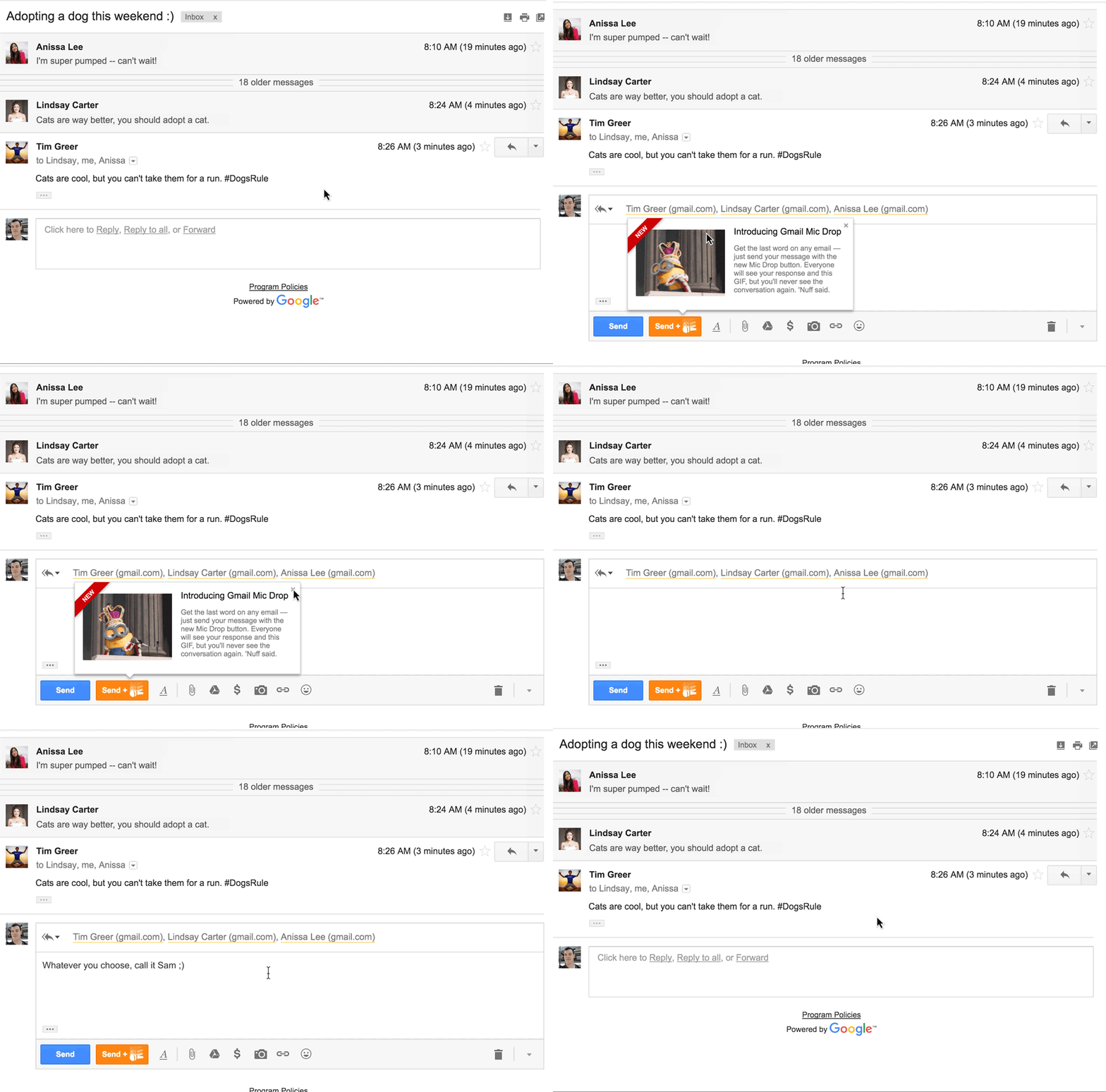
Did anyone take a screenshot of the Mic Drop button before it was removed? There are GIFs showing the sent email with the minion, but could find any showing the /button/ in action.
I would guess they missed the idea that people use muscle memory to close irritating pop-ups without trying to figure out why it's there, or what it relates to. They are then left with 2 send buttons, one with a now ambiguous microphone icon.
Unfortunately, the popup Google chose to use looks like an advertisement. The red "new" banner and animated gif.
They might have reacted differently to an actual dialog at first click that says "This will inject an image into your outbound email, and mute the conversation. Continue?" (with the default choice set to "NO".
It would be cool if websites didn't pop up dialogs for stupid reasons. 90% of dialogs that appear without user interaction are intrusive and unnecessary so users get used to closing them. Would you like to take a survey?, download our mobile app?, full screen ads, and my favorite - "our site has changed dramatically, here's a tutorial."